Showing posts with label combination. Show all posts

Saturday, April 24, 2010

Recognising Eureka Moments

Do you often get the ... "Wait a minute, there has to be a combination here." but the life of you, you just cannot find it over the board?

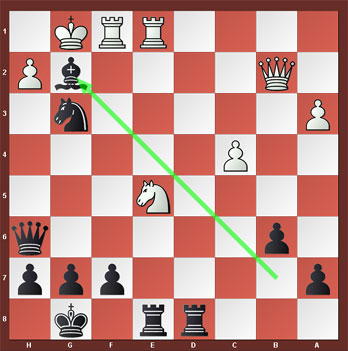
Here's a small little snippet of a position I played a few days ago on FICS.


My opponent White, just played 30. Qc2

It was at this moment that something in my mind clicked about the position and that little voice in my head then said, "There's something in here."So I began calculating....

1. If it is White's turn to move, what is White likely to do?

My king and queen are currently not under threat. Neither are my pieces with the exception of the e4 pawn and possibly, the c6 pawn once the Knight on c5 moves. The Knights are likely to take the e4 pawn first and coupled with the a-pawn push, White would be winning.

I need to find something and fast.

2. Can I stop White's threats of taking the e4 pawn with any pieces?

No, the pawn is being attacked 3 times. The only way to defend is f5 but my exposed King would be quite vulnerable along the b2-g7 diagonal. I can take the chance but I don't like it.

3. Let's look at the safety of the White king and queen now

I looked at the White King's position, it's extremely vulnerable along the dark square diagonal of g1-b7 but that diagonal is defended by the pawn chain of e3 and d4. I'd notice my bishop targetting the rook on a1 so if my Bishop can plonk itself on d4, I would be an exchange up then. So how do I remove this pawn defence?

Once I saw this, I found the combination. All I need to do now is to recheck any variations that might interfere with my plan. Seeing none, I looked to see if there are other good moves I can make but could not find any. So I played....

30....Nxe3 31. Rxe3 (forced as other alternatives are poor eg. 31. Qxe4 Qxe4 32. Nxe4 results in 32. Nc2 forking both Rooks and I would be the exchange up with a very active bishop and 2 rooks - Black is winning) Bxd4 32. Rae1 (see diagram below)


And the pin along g2-a7 diagonal decides matters - the White Rook on e3 is going nowhere. So, I take my time 32... Qxc5 33. Qxc5 Bxc5 and the game quickly finished.

I admit this was one game I got lucky. I didn't see the 30th move until it presented to myself. In an actual game, I would have to see this move well ahead in advance.

However, one good thing arising from this is that once I recognise the pattern, I can now "lock" this useful idea and store it into my "brain" database (and my PGN database of games) of tactics I can possible use in the future.

And it is only by consistently building "chunks" of tactical patterns, that will help create ideas and help formulate plans in the future.

Thursday, June 25, 2009

Tactics Puzzle

Here's an interesting position I just played on FICS.

Hint: Black to move and win material.

Answer can be found by highlighting between the brackets
[1. Bxe4 Bxe4
2. Nxe4 Qxe4
3. Re8 Qf3
4. Rxe3! and White cannot take the Rook back because of Bd4 pinning the Queen]

Friday, February 27, 2009

Some Days .....

are just not meant for playing chess.

I just finished this blitz game when my opponent ran out of time. A couple of moves before the end, we arrived at this position.

White had just played

1. Rc1

Now what is the quickest path to victory for Black?

I totally didn't see it and played another move instead (D'oh!)

What was it that I missed?

Answers can be found by highlighting between the brackets.

[The killer move was:
1..... Qc3!!
White has no defence as the Queen must be taken else it's mate in 1.
2. Qxc3 bxc3
and now White cannot stop mate in 2 by Black after
3.... Rb8+ and 4.... Ra1#]


Friday, January 16, 2009

Forced Recaptures

This game was played a couple of days ago and I admit it's not easy to see the idea behind it.

I am White.

I am down a whole Rook for 2 connected passed pawns on the g-file and h-file and now Black had just played 1.... Nxf2 forking my Rook and Bishop.

It's definitely not easy to spot this but I had actually planned it to tempt the Knight to play Nxf2 (a juicy fork is always tempting especially when you're a piece ahead).

And this time Black fell into a very nasty trap I laid for him.

Can you see White's response?

If you want to puzzle this over before looking at the answer (with diagram), please do stop here now.

White to play and win.

------------- Answer ------------

Have you seen my idea? If you haven't, don't worry. Ready?

The idea is to play

2. Bg2!!

If the Knight does not capture the Rook nor block the h-pawn (I'll give the continuation after 2.... Rh8 later) then

3. h8=Q Rxh8
4. Rxh8+ followed by
5. g8=Q gives me a new Queen

So Black played

2... Nxh1


And now comes the shocker

3. Bxb7! (see 2nd diagram)

and now it's game over.

If 3... Kxb7
4. g7 and one of my connected pawns will be traded for the Rook and the other pawn will Queen easily.

If 3... Rh8
4. Bxh1 with Be4 to follow and then g7 and there's no stopping any of the pawns to queen and the Rook will still be lost in the process.

Oh if 2.... Rh8 then I would win transpose into the lines mentioned above after 3. Bxb7 and either .... Nxh1 4. Bxh1 or ... Kxb7 4. g7

Black chose the continuation after 3... Rh8 and resigned a few moves later.

This brings to mind an important rule: You are not always forced to recapture a piece that has just been captured. Always be on the lookout for tactics and combinations.

PS: I'll be away on holiday for the next couple of weeks, so till then, cheerios, everyone and take care.

Saturday, January 10, 2009

Calculating Forcing Moves

GM Larry Christiansen (of ICC's Attack With LarryC column) is a renowned fierce attacker.

Here's what he once said about tactics and combinations.

He quotes,"One extremely important point I wish to emphasize is to always look at forcing moves.... As a player, I tended to calculate fairly deeply but I would often abandon a tactical possibility just when it seemed to lose its feel."

What Larry Christiansen means is that when you're about to embark on a dangerous combination, you should always try to calculate it to its very end.

Here's a game I played recently on FICS.

White in order to get over the misfortune, tried to castle his king into safety with the move 13. O-O and of course, this meant that this move was a case of out of the frying pan and into the fire.

It's Black to play.

a. Can you calculate how to take advantage of this situation?
b. How far did you calculate? Where did you stop?
c. What are White's responses to your possible moves?

In this case here, I calculated the above to its natural conclusion. So if you feel like giving this a go, Please stop reading now if you want to work this out for yourself.

----------- Answer below ---------------

I'm sure most of you would have found the immediate move
13.... Nxe3
14. fxe3 Qxe3+

Now here's the trick. What are White's responses?

A quick calculation reveals that
15. Kh1 loses a piece after
15.... Qxe2
16. Qxe2 Bxe2 so this line can be quickly discarded by White since Black will win.

But are there any possible responses?

15. Rf2 was the only other option.

Okay, the Rook defends e2 and blocks the check. The phrase "blocks the check" should now stir something in your head.

How do you make use of this pin?

15... Bc5! is the killer move. The rook is only defended once by the King so putting additional pressure on the pin makes sense.

Can White defend it? The only move left is:

16. Qe1 (White Queen has to defend the d2 Knight, e2 Knight and f2 Rook) (See 2nd diagram on right)

If you've calculated this far, can you now apply the correct combination?

16.... Bxe2 and now it's over. The rest of the game as follows and this is what happened:
17. c4 (White is paralyzsed as any other moves does not affect the outcome) Qxf2+
18. Qxf2 Bxf2+
19. Kxf2 Bh5 winning with a whole Rook up
White resigns

Surprising, all these moves are forced. And if you found this line (like I did), it's kind of amazing that you had actually calculated some 12 ply moves in all.

Friday, March 7, 2008

The Remainder Is Just A Matter Of Technique

Don't you just hate it when some chess author goes into a sequence of moves and ends the variation with "winning is just a matter of technique". This normally happens when the final position is a "strategically won" position.

But what is a "strategically won" position? Does this mean that if I play less than optimal moves, I will still be able to convert that advantage into a win?

Is chess really that simple? Is it really a game of "my opponent goes there, I go here" like what Closet Grandmaster mentions?

Not exactly.

Alexei Suetin, in his book 3 Steps To Chess Mastery, explains that what the phrase means is that, "By a strategically won position, we normally mean the achievement of an objectively big and very stable positional advantage, which with correct play, can no longer be shaken. However, to convert such a position into a win, as we know from numerous examples, is not always a simple matter. Accurate realisation of an advantage is one of the indications of a high standard of play."

Now isn't that the truth. :)

Converting the advantage is not easy indeed.


Take the following position that I had (see picture on left). I am White. This position arose out of the Sicilian Dragon (I've got to admire these fanatic Dragon players for their tenacity).

Black had just moved 17.... Be5 and I made the move 18. Qh4

The outcome and result of this game is of little importance.

I find this position somewhat fascinating and it's good to setup the position on an actual board. I've given questions that I often ask myself in practical game play. I find this to be a very good technique towards improving my analysis skills and I encourage you to do the same. Before looking at my suggestions/replies to the questions, try to work it out yourself.

What is important is the following:

Have a think and work through this process:


Question 1. How would you evaluate this position?


1) = Even position
2) White +/= (Slight advantage)
3) Black =/+ (Slight advantage)
4) White +/− (Advantage) or +− (Decisive advantage)
5) Black +/− (Advantage) or +− (Decisive advantage)

If you said (4), you would be correct. White has a very strong advantage. Which leads to the next question that had to be asked:


Question 2. Why is the position considered a strong or decisive advantage for White? Try to work it out on the board before reading on.

Let's examine this more closely.

A strong advantage usually indicates that either the side with the advantage has a winning attack or more likely, has a command of space and position.

Have a look at the board (if you've set it up) and now ask yourself.

I've reproduced the diagram again on the left for your convenience.


Question 3. How many squares does White attack or control? Try to work it out on the board before reading on.

Now take a look at the picture on the left.

I've highlighted all the relevant squares in yellow. These are squares which White has control of or can attack and compare with the squares that you try to visualise on your board. Do they match?

If you fail to see all the squares, do not fret. You're in good company because I failed to see some of the highlighted squares too. :)

What this means is that because we are unable to see the squares, we have inadvertently limited our attacking opportunities when they arise. As a result, we tend to make sub-optimal moves because of our limited "chess vision". With constant training, this defect in our chess thinking can be corrected.

Anyway, back to the task at hand.

Now we know that there are a lot of squares being attacked/covered by White's pieces. As a result, Black's pieces are severely restricted. And by restricting your opponent's pieces, you have more room to manoeuvre your pieces into winning positions or positions which can give rise to winning tactics, combinations - which brings me to the next question.

Now look at your board (if you've set it up) again.


Question 4. Given that we now know which squares that White can control and possibly launch an attack from, do you see any tactics/threats/combinations that White can perform from these squares? Please do try to work it out on the board before reading on.

Tactics, combinations and strategies are the main motifs of chess play.

With tactical and combinational vision, one is then able to come up with a plan (be it a long term plan or a short term plan) and work out a coherent strategy to convert that to a win.

Now take a look at the diagram on the left.

I am looking at this without Fritz running at the moment and I'm sure I will possibly have missed some moves. But of the position, 3 major combinations come to mind.

The first combination that popped in my mind are the ones highlighted in yellow.

#Threat 1 (highlighted in yellow). White is planning to take on the g6 pawn with hxg6. After that, the h-file is open and White is threatening to mate on h7 or h8 (if the dark square bishop moves from the a1-h8 diagonal).

This threat should be on the fore front for most of us.

#Threat 2 (highlighted in Green). White is planning to attack on the Queenside with moves like either Bb6 (attacking the Queen) or Nb6 (attacking the Rook on a8).

Usually a good plan of attack especially when the opponent has less mobility is to create a 2nd weakness in your opponent's camp. This is called the Principle of Two Weaknesses (PDF link to Dvoresky's ChessCafe article) and has been effectively employed by all World Champions and many of the world's elite chess players to great effect.

Threat #3 (highlighted in red). I love this threat the best, not because it's the strongest but because of the trap. If Black tries to defend, White has the possibility to play Nc5! It took me a while to see this move but in the end I saw it. Now White threatens to take on the light squared bishop with Nxe6 and if fxe6, hxg6 (which in combination with Threat #1 threatens mate soon). The Knight cannot be taken with dxc5 because of Nf6+, winning the Black Queen.

If you see any combination I missed out or find any refutation to any of the above combinations, please do let me know. I am constantly trying to improve/streamline my thought process and this would help me and others heaps. Thanks.

That's pretty much it for now. By explaining all the steps, I hope to share with you how I play/visualise chess. I don't profess to say it's the best but it has helped me immensely as a low rated player towards the long road of self improvement.

As a final quiz, my opponent played 18... f5. See last picture on left.

What do you think is the strongest reply?

Examine the possibilities and see if any of the threats you analysed earlier can help you to come up with a winning plan/combination.

Till then, cheers and good luck. :)

Sunday, February 3, 2008

Oops! I Did It Again

In one of my earlier posts regarding Fritz 11, drunknknite spotted my error and corrected it. I had inadvertently keyed in the wrong move which explains why Fritz 11 went zonkers.

I apologise to everyone all around and would like to express my utmost thanks to drunknknite.

I've received dk-transformation 's excellent GM database and have finally gotten around to dissecting this wonderful database. It's quite mind-boggling, to say the least and clearly can only get better as dk-transformation continues to update it. My hats off to him for an incredible job!

My current rating on FICS is around 1300-1350 and on the basis of the following play, you can see why.

I have identified my weakness and that is tactics. In this game, despite this strong attack, I actually lost the game in the end because after this, I made not one, not two, not three but FOUR weak moves which basically erased any advantage I had.

In this position after 18... Nge7, White to play and win. I failed to find the correct combination and was severely punished for it and rightly so, I might add!

Can you find the strongest move?

Answer can be found by highlighting between the brackets.

[ It is checkmate in 8 moves. The beauty of this is to sacrifice your Knight.

19.Nc5+ dxc5 20.Nxe5+ Ke8 21.Qa4+ Nc6 22.Qxc6+ and Black cannot stop mate. If 20... Kd6 21.Nxf7+ Kd7 22.Qa4+ Nc6 23.Qxc6+ Ke7 24.Qe6#]

Thursday, January 24, 2008

What Do I Do Next?

I've reached an interesting position here arising from the Ruy Lopez: Berlin Defence.

Black just played the move 22... Ne5. I fail to find the correct tactic here, proving once again, my tactical vision is just not good enough. Instead, I found the 2nd best move which Fritz gives as less than optimal - difference of 1.0. A swing large enough to highlight my omission.

My question is this:

What is wrong with Black's position? In this case, I'm not giving out any clues. It's up to you to figure out the best continuing line.

[In the game, I played 23. Nxe5. But I missed the following stronger tactic.

Surprisingly, White can solidify his advantage by playing
23. Nxd6!! The Knight naturally cannot be taken by the Black Queen because if 23... Qxd6 24. Qh6#.

23.Nxd6 Nf7 (forced as any other Knight moves either loses the Knight or results in Qh6#. Note: If the Queen tries to defend with 23... Qe7 then 24.Qxe5+! Qxe5 25.Nf7+ loses a piece
24.Nxf7+ Qxf7
25.Qxc5 and White has netted 2 extra pawns]

Sunday, January 6, 2008

Angry At Myself

I am so angry with myself. I had seen the tactic but I played it incorrectly.

I should have lost but I won because my opponent blundered. The tactic I used was correct but the process was wrong.

Without further ado, let's examine the following (see 1st picture on right):

White just played

26.Nd3

I ran this through Fritz and Fritz pretty much preferred the following continuation:

26... Ne7 27.Kf1 Bd5 28.Nh4 Qe4 29.Qxe4 Bxe4 30.Ke2 Kf8 31.Ra7 Nd5

Where Black has a slight plus. Instead I threw a huge monkey wrench into the works. I played....

26... Ne3!

I had calculated carefully that I will win back my temporarily sacrificed piece should my Knight be taken. And indeed it was. But Fritz thought nothing of and reckons I'll still be alright after the correct defense:

27. Nh4 Qe4 28.Nxc5 bxc5 29.fxe3 Qxh4 30.Qf2 Qe4 31.exd4 cxd4 32.Qg3 Qe2

Instead White took the bait and played

27. fxe3 Bxf3
28.Qxf3 (see 2nd diagram on right)

This is the point I strayed and should have lost.

I played 28... dxe3

This was highly incorrect because White has the tactical shot which he played during the game.

29. Ra8! Rxa8
30. Qxa8+ Bf8
At this point, my opponent miscalculated. He should have played
31. Bb4 which is the killer blow and White pretty much wins in all variations.

The correct move I should have played was

28... Qxd3

Now the Bb4 trick does not work because after

29. Ra8 Rxa8
30.Qxa8+ Bf8 (see 3rd diagram on right)
31. Bb4 Qxe3+ and Black will go on to win the Bishop through a series of checks.

Back to the drawing board.

Addendum:

At the request of Greg, I've attached my full game below.

Saturday, December 29, 2007

Setting Traps

In chess, setting traps can be fun. Especially when your opponent falls headlong into it.

By the way, I am not encouraging people to set traps. There are 2 problems with setting traps:

1. Your opponent detects your trap, you're well and truly busted
2. You didn't calculate deep enough and your trap ends up busting you (sort of like the Roadrunner cartoons).

In this case here, have a look at the following position.

This position arose out of the Sicilian Najdorf. I am White.

Black just played 23... a5 (see 1st diagram on left).

I was half tempted to play 24. g4 and do the usual pawn race (as so often happens when both sides castle on opposite sides) when I thought I play a little trick.

I didn't really think my opponent would fall for it but it did work.

The move I played was 24. Rhf1!

I know what you're thinking.... you just gave up a pawn!

Anyway, my opponent grabbed it without hesitation.

24. ....Bxh4 25. Rh1 Be7 (see 2nd diagram on left)

Now what has changed from the position?

Do you see what I see?

Yes, the next move is of course..... *drum roll* the classic Bishop sacrifice!

26. Bxh6 gxh6 (I ran this past Fritz and Fritz didn't even consider retaking the Bishop)

27. Rxh6 Bg5

My opponent tries to block the g-file but it's too late.

28. Qg3 (pinning the Bishop) f6
Once you start an attack, you don't stop.

29. Nf3 (no prizes as to what I am doing next)

Curiously enough Fritz gives this as White as having a winning advantage... Fritz tried a multitude of variations that I've reproduced below and none of them were sufficient to stop White's attack.

Analysis by Fritz 10:

1. +- (6.92): 29...Be8 30.Nxg5 Qg7 31.Rdh1 fxg5 32.Qh2 Rc7 33.Rh8+ Kf7 34.Rh7 Rg8

2. +- (5.11): 29...Qg7 30.Rg6 Rc7 31.Nxg5 fxg5 32.Rxg7+ Rxg7 33.Rxd6 Bxe4 34.f6 Rh7 35.Qxg5+ Kf7 36.a3 Re8 37.Qg4 Rh1+ 38.Ka2


29.... Bxe4
30. Nxg5 fxg5
31. Qxg5+ Kf7 1-0

At which point my opponent resigns as he will fall into a multitude of problems and White wins in a variety of ways.

The last picture on left paints a sorry tale for Black.

The Queen is getting skewered with 32. Rh7+ and Black is going to get mated eg. 32.Qg6+ Ke7 33.Rh7+ Rf7 34.Qxf7+ Kd8 35.Rh8#

Friday, December 21, 2007

One Of My Most Difficult Games To Date

I've been meaning to get around to annotating this game that's been sitting inside my database for 2 weeks now.

And I'm still not sure if I made the right moves. I'll need to arrange a time for Fritz to give it a look through.

This game was hard.... very hard. Because it took me a long time to get the position I am now. I am Black and it is my turn. This game arose from the Closed Sicilian without g3 (B23). See 1st picture on left.

Both my opponent (rated 1500) and I were trying hard not to make mistakes and we had consumed copious amounts of time and we were now in a bit of time trouble having played 24 moves each.

My pieces are slightly better coordinated than my opponent's. My king is relatively safe in the center and my pieces protect one another (in harmony - which is very rare for me).

The position looks quiet but threatens to explode at any moment and I felt the next few moves are critical and would determine the outcome of the game.

I took a long time over my next move. First I scanned my opponent's threats.

The Queenside is all locked up.

My first inclination was to play 24...Kc7 or 24... Kc8 and move my King inwards away from any stray threats.

My worry here was that White can play d4! And after either cxd4 or exd4, suddenly White's pieces are free, the light square bishop can go to Bb5+, his Rook can shift to the Queenside and suddenly I've got holes everywhere on the Queenside (see the red arrows in the 2nd picture on the left)

Not good.

But while thinking of the King move, I suddenly realised that White also has the release mechanism c3! at his disposal which threatens to shatter my Queenside and Qc2 and Rc1 is going to be problematic.

I feel I need to strive and take over the initiative now.

White has weakness on the light squares. If I can engineer a break through on the light squares, I just might be able to take over the initiative. So I relook again at the board (see 3rd diagram)

My Bishop stands marvelously on b7 and it has its trained eye on the weak e4 pawn. This is the square I plan to break. If need be, I can quickly shift my Queen to a8 and double on the diagonal to give the Bishop more power.

I decided to go for broke and play 24... d5!

In case you haven't noticed, I've also laid a little trap for my opponent. Can you spot it? :)

If you did, good for you. Because my opponent didn't. He fell headlong into it and missed the following forced combination.

25. Bxh6?? White thinks it's winning a pawn and threatening Bxf8 but in reality, White is losing as now the following forced sequence reveals itself.

White missed my immediate reply 25... Nxg4+! The Bishop on h6 is threatened so White is forced to take my Knight.

26. hxg4 Rxf3
27. Rxf3 (see 4th picture on left) and now the moment reveals itself....

27.... Bg5!

Now I gain back my piece. More importantly, I've traded off White's important dark-square Bishop, I have a nice open h-file for my Rook and I forced the White Queen to retreat. Sweet.

28. Qe1 Rxh6+ 29. Kg2 Bf4 (blocking the f-file from the White's Rook and threatening Qh4 with Qh2+ and White will get mated soon once I take the Knight (removing the guard on the square h1) with my Bishop.
30. Qg1 (protecting h2 and attacking c5 pawn) Qe7 (I saw this of course, no way I'm letting his Queen break the Queenside. I'm not worried about White playing the d5 pawn since it's poisoned)
31. Nf1? (hmm.. my opponent is panicking. He just opened up the diagonal for my Bishop) dxe4
32. dxe4 Bxe4
33. Bb5+ Kc7
(see last diagram on left)

White's pieces are all tied up. The Rook is dead, the Knight cannot move anywhere, the Bishop is free but aims at nothing, the Queen cannot move and White has weaknesses on the d and h files.

White has run out of tricks and I won the game shortly after a few more moves.

Monday, December 17, 2007

My Year In Review: Part 1

Has it ever happen to you? You wake up one morning, and you realised the world has passed you by.

It happened to me this morning. As I realised to my horror, I'm starting to fall pretty badly behind my peers at the chess club. Joshua, Arthur and Ted are making marked progress and are now in the 2000 stratosphere while I am still languishing in the sub 1500s.

I formulated a plan a few months back of consistent studying and playing but have since abandoned it because my work plus studies took its eventual toll and I could no longer keep up with the strict regime without my studies suffering.

I hate making resolutions for the new year because in the end, inertia sets in and I'll fall back to my old ways. As a result, I have to put my foot down now and that is to start playing more OTB chess consistently and regularly. I am thinking of joining the chess club at North Sydney Leagues club every Tuesday night once the new year starts and commit myself there.

I play online games a lot more these days now that my studies won't start till mid-February 2008. In between now and then is probably my last hope of taking my chess skill to the next level ie. the 1500-1800 level.

I am still making improvements albeit in small steps but I need to be at the point where I have to make big strides instead.

And that means, on the top of my list in order of importance:

Master endgames and I don't mean just learn it. But MASTER it. I've got a few books lined up:

Sherevesky's Endgame Strategy (which I am currently reading),
Muller's Endgame DVDs set (1-4),
Muller's ChessCafe articles,
Smyslov's Endgame Virtuoso,
and finally, Dvoretsky's Endgame Manual.

and I've got Total Chess Training software to work through.

I will still continue to work on combinations and tactics in the meantime.

Today, I was reviewing one of my online games, adding annotations and letting Fritz do its handy work when I noticed 2 particular variations and I thought it was very instructive so I'm going to post them here.

Have a look at the first diagram on the left, this 1st test position was the result of a rather long variation given by Fritz.

I was White. Black decided to take the pawn on e4 with:

1. .... Nxe4

Here's the question:

Problem #1. Can you see how White can win here?

The answer can be found within the brackets

[ Yes! White goes for a mating attack starting with...
2. Nc6+
Black has 2 possible continuations and both of them lead to mate.
2.... Qxc6 3. Rxe8#
2... Ke6 3. Qd5#]

The second one here is tougher. See the 2nd diagram on right.

The position has somewhat changed. Black played

1.... Nxe4

The question is this:

Problem #2. Can you find the best move for White?

Answer can be found within the brackets

[ If you chose
2. Qg4+ Kf7 3. Qxe4. You didn't see a stronger move.

The correct answer is:
2. Qg4+ Kf7
3. Rg8!! (Now comes the point of this move. Black is forced to capture the Rook with the Queen) Qxg8
4. Qxd7+! and now 4... Kf8 leads to Qe7# and 4... Kg6 leads to 5. Ne7+ forking King and Queen]

To tie things up, I jumped onto FICS and played a few Blitzes for fun. I lost the first game (making a horrible endgame blunder when I should be winning..... grrrrr.) and won the next one which I've highlighted here (*insert chest-beating Tarzan yell*). The following game itself is not great at all. But I do notice that I am processing faster with my tactical vision (my opponent making things easy for me didn't help matters). I guess all this self-study is showing its results. In all, I took 3 minutes for the whole game. I am going to go cold turkey on Blitz games for a while.... at least until I get my endgame technique down to a pat.

Sunday, December 2, 2007

All Worth It

Folks,

Here it is (see diagram on right) , the reason why I:
a. forfeited my last 6 games in my chess club competition
b. took 1 week of annual leave from my work
c. woken up with "keyboard" face (aka. falling asleep at my keyboard) more times than I can count
d. ate instant noodles the last 8 days

My next study term doesn't start till February next year. So I have a good 3 months to brush up on my OTB chess skills. *grin*

Now that we got that out of the way, I thought I take a little breather (especially after that last post) and post a small little review of a Chessbase (yes, the nerds from Germany- I can't count the number of times that website has pictures of attractive looking women playing chess which is highly embarassing) DVD.

It's a slightly dated DVD. It's from GM Daniel King's PowerPlay 1 DVD - Mating Patterns.

Yes, it's another less than veiled attempt by Chessbase to seduce you to part your hard-earned money.... and to provide GMs with some additional income.

Btw the picture on the right of Daniel King is not him asking you for a handout (although it may appear to be so) nor to buy more of his DVDs (which he certainly won't mind).

Bad jokes aside, in this DVD, King explores in detail the following main mating patterns:

a. the Greek gift sacrifice
b. the Lasker double bishop sacrifice
c. the Lawnmower Mate
d. the Bishop See-Saw
e. the H-file Rook distraction
f. the Knight mate
g. the Back Rank mate

In each of these patterns, King throughly explains the combinations needed to carry out each of these tactical treats successfully and when to recognise the tactics fail.

I have to say that among other commentators in other Chessbase DVDs, he is one of the most interesting commentators and there's seldom a dull moment in his presentations.

King is precise, clear and engaging. He also slips in a few jokes to keep up the interest of the viewer, which I think is wonderful in that it breaks up the monotony - especially if you've been viewing 3 or more lectures (like I have been doing) consecutively.

In all, there are approximately 40 lectures and 11 exercises in this DVD, totaling about 4 hours.

The only caveat of this DVD is that most of these tactics can be read from say, Vladimir Vukovic's classic The Art Of The Attack and there is little fresh material here if you are already versed in these mating attacks.

Most of the lectures start off from middlegame positions where tactical shots abound.

There's a minor quirk here. King was puzzled at one stage on how to remove the arrows he had placed all over the board and had to ask, "Mr. Cameraman, what am I doing wrong?" which clearly demonstrated his unfamiliarity with the ChessBase user interface. *tsk tsk*. ;)

But other than that small slip, his annotations are excellent.

Now the million dollar question. Will I recommend this DVD to other players?

Well, I am quite tempted to ask you to read Vukovic's classic and other well known chess tomes instead. This DVD fills the gap for an improving player who has little time to study and wants an introduction to the world of mating attacks and mating combinations.

I would rate this DVD more suitable for beginners to early intermediate players.

Oh, I find the review at Chessbase on this DVD is pretty much spot on.

Friday, November 30, 2007

Candidate Moves

First off, I apologise for the length of this article. This position arose out of the Queen's Indian Defence (notice how I play a variety of openings?). Make sure you have a good cuppa ready before delving into this article. Really.

In this article, what I am trying to do is put my thoughts down so that I know how my thought process works and check with other chess engines to fine tune my thinking process. I think this is a good step (as advocated by Blue Devil Knight on his Confessions Of A Chess Novice blog) towards improving your chess skills.

Anyway, back to the game (I am Black):

21. Qxe5. (see 1st diagram on left)

A few questions popped in my mind at the moment but one that is most important.

Should I move my Queen?

If I trade Queens, I liberate and free White's bishop after (21... Qxe5 22. Nxe5). My position has weakened. White has a strong Knight on e5 and my bishop is in a nasty pin. I could always retreat my Knight to the safe outpost on c5 to protect my Bishop but after (22.... Nc5 23. Bxb7 Nxb7). My pieces are all on the last 2 ranks and I am losing valuable tempo having to reactivate them. No, I am determined to strive for activity here and take central control. To do that, my Queen has to stay on the board.

Allowing White to trade Queens with (22. Qxc5) is not in my best interests either as I have to retake with my Knight else my pawn structure is fractured (if I do 22...bxc5) and we run into the same situation with (23. Bxb7) again (as I mentioned earlier). Hence, I need to move my Queen. So what candidate moves are there?

(21.... Qxc4)
(21.... Qxe3+)
(21.... Rfe8)


I discarded (21... Rfe8) immediately since I need to move my Queen.

(21... Qxc4) is nice, winning a pawn but that pawn is absolutely going nowhere. The pawn is isolated and that means that it is weak. When the pieces come off the board later, White will have difficulty defending that pawn anyway. Thus, I didn't think there's a rush to take the pawn for now. It's nice but not the best move, I thought.

That leaves (21.... Qxe3+). Now we're talking. Taking a pawn and giving check, winning a tempo. Don't forget that sooner or later one of the White Rooks is going to come and plant itself on the e-file so in this case, taking the most forcing move to gain a tempo is crucial. I chose the most forcing move.

21.... Qxe3+

Fritz apparently loves the idea of Qxe3+.

22. Kh1 (forced) Rfe8 (to get the Queen off the e-file)

23. Qb2 (forced) (see 2nd diagram on left) as White has to stop any potential Nf2+ tricks

Now we come to a curious juncture. White's move Rae1 or Rfe1 is definitely coming but if I calculate this right, I should be able to pull my Queen away from it in time.

At the moment, there are no obvious threats to Black. So I followed Makaganov's Famous Rule which is,"In a position where there are no immediate or direct threats, improve your worst placed piece."

So what is my worst placed piece?

Evidently my Rook on a8. So I moved it.

23.... Rad8 (taking control of the d-file)

It so turns out that Fritz also favoured this move.

Other considerations given by Fritz were (23....Nd6). Honestly, this move didn't occur to me because I have the positional advantage. Why give it away by retreating the Knight from its central outpost where it covers a lot of squares? The only thing I have to be wary of is my Bishop on b7 (which is unprotected) so I need to keep a close eye on Bb7.

24. Rae1 (surprise, surprise)

I thought this over for some time. My candidate moves were:

(24... Qc5)
(24... Qc3)
(24... Qd4)


Let's consider each move in turn.

(24... Qc5). I didn't really like this move. It moves my Queen, protects my Knight. But it doesn't threaten anything.

(24... Qc3) I didn't really feel like trading Queens at this point.
(24... Qd4) Same as above.

Then suddenly a thought came to my mind.

(24.... Qh6) Nice. I am threatening (25... Nxg3+) next. I've always loved moves that threatens my opponent because it forces my opponent to halt his attack to perform protective duties.

Only problem is: What do I do after that? So I start to explore this line further. What can White do?

(25. Ne5?) Possible. The Knight is threatening (26. Nxf7) forking Queen and Rook. But that would lead to (26... Nxg3+) forking King and Rook. If I take the Rook subsequently with (27...Nxf1), White can't play (Nxf7) anymore. But then I run into the problem of (28. Bxb7 Ne3) and then (29. Qc3!) (protecting both Knight on e5 and attack my Knight on e3). I also have the added problem of a possible Bd5 in the future where my f7 is coming under enormous pressure. I gained a Rook for my Knight but more importantly I have lost the dynamics of my position and White despite the small tradeoff, may even gain a slight advantage .

Surely, there must be another way. Ah yes, I found it (I'll explain later). I played

24... Qh6! Fritz complains here, preferring (24.... Qc5).

25. Ne5 (expected) (see 3rd diagram above on left) Nxg3+

26. Kg1 (forced)

Now comes the intermezzo move that took White evidently by surprise.

26... Bxg2! (see 4th diagram on left)

Fritz liked (26... Nxe1), taking the Rook first. However, I have a little trick up my sleeve.

Can you see the trick?

Let's see what White can play.

His Rook is obviously under attack twice. So let's consider the candidate move:

(27. Rxf7)

I'm going to take time out here and consider this variation so you have a good idea why this move is bad. There's a problem with this move. Because Black has an even more surprising move in store.

(27... Ba8!!) (see 5th diagram on left) What??!! You probably ask.

Here's the nasty trick.

White cannot play (28. hxg3) (taking the Knight because of (28... Qh1+ - highlighted by red arrow - 29. Kf2 Qh2+) skewering the undefended Queen.

If White doesn't capture the Knight and moves his Rook on f7 away, now comes the killer move:


(30.... Rd2) (highlighted by the yellow arrow) (threatening 31...Qxh2 followed by mate so White must give up the Queen)

If Knight on e5 moves to f3, Black trades Rooks anyway with ... Rxe1 followed by ...Ne5 (yellow arrow) and ....Rd2 and the position is absolutely crushing.

Now let us return to our position (see diagram on left) after 26... Bxg2.

27. Qxg2 (forced because 27. Kxg2 runs into the horrible fork 27....Rd2+! winning the Queen)

Now (27. Nxf7 doesn't work because of 27... Qg6 28. Nxd8 Be4! with threats of 29... Nxf1+ or 29... Ne2+ and best of all, White still cannot play hxg3 because of mate on g2 after Qxg3+)

Now let's get on with what White actually played.

28. Nxf7? (see last diagram below on left)

And now the final trick presents itself.

28.... Qxh2+!

And White is now busted. Interestingly, Fritz didn't like this move. Well.... duh. Of course I am going for the endgame and trade off the Queens.

29. Qxh2 Nxh2
30 Rxe8+ Rxe8 (White Resigns as he is a whole Rook down)

1-0


Phew.

I have no doubt that my chess skills is not up to scratch and my piece co-ordination still lacks finesse. This is an area I definitely need to improve upon.

Tuesday, September 18, 2007

Ugly Moves

How does one improve chess skill?

I've been pondering over it the last few days.

When one looks at chess position OTB, how does one know instinctively if a move is good, bad, could be better? In chess, the common problem with patzers like me is that I tend to make average moves. Even worse, in a complicated tactical position, I have a problem of either:

a. Not calculating variations deep enough
b. Being oblivious to my opponent's threats

The answer unfortunately, that I have arrived is that I need to do more tactics. If I have tactics down pat, I should be able to logically figure out what moves are optimal and what moves are not. I am currently looking for a couple of Chess Books/CDs/DVDs that are not just 1-2 moves but 4+ moves to in order to improve my tactical skill (or as some people like to call it, chess "eye").

I am quite frankly tempted to shell out some money to get some help (I can't afford a chess coach) rather than working on blindly with no direction whatsoever. Reinfeld's 1,001 Combinations is fine and one can blitz through it in record time because of the 1,2,3 move combinations that stick out in your face at once but I need something more in-depth. I am well open to suggestions at this point in time to anything.

On a sidenote, with my finals coming up soon near the end of October, I can afford precious little time (not to mention, I need to concentrate more on my 2 exams this week *yikes*) to concentrate on chess studies.

Saturday, September 15, 2007

Combination #2009-09-15

This game was taken from Botvinnik's 100 Selected Games. The year was 1927. Young Mikael Botvinnik, at the age of 15, participated in the Leningrad tournament in a strong field of 6.

His opponent in Black here was Grigoriev. Black had just played. 27..... Kh8.

What did the future patriarch of Soviet chess see in this position?

Highlight the text between the square brackets for the answer
[28. Rxe5! dxe5 (28... Qxe5 29. Qxf8+ Ng8 30. Qf7 Nf6 31. Rd1 guarding the back rank +-) 29. d6 Qd8 30. dxc7! Qxd2 31. Qxf8+ Ng8 32. c8=Q Black resigns 1-0]

Monday, September 10, 2007

Trap #2007-09-10

On FICS today, I encountered the following position. The position looks roughly even. My opponent just played 23... d3 which I think just simply loses the d-pawn and the ensuing endgame looks to be winning for white. However, I thought over this position for a while then decided to lay a little trap for my unususpecting opponent... guess what did I play?

Highlight the spaces between the brackets for the moves.
[24. Bc4+ (24.. Bd5 was needed but this simply loses the d-pawn for nothing) but my opponent fell into the trap and play continued with 24... Kg7? 25.cxd3 Bxd3?? (25... Bd5 was again necessary) 26. Re7+ 1-0 as Black loses after 26....Rf7 (26... Kh8 27. Rh1#) 27. Rxf7+ Kg8 28. Rd7+ Bxc4 29. Rxd8+]

Friday, September 7, 2007

Combination #2007-09-06

This was played in a 10 minutes blitz game in FICS. I am Black.

White just made the horrendous move of 28. Re1-h1. Do you see the deadly error that White made?

What would you as Black play? Probably not the move I played!

Highlight the text between the brackets for the answer [I played 28... Ne3! Urgh. While not a terrible move, I missed the mating combination. I should have played 28... Qe2+ 29. Kh3 (29. Kg1 Bc5 mates) Ne3 (and White is powerless to stop mates on Qg2 or Qh5)]