Friday, November 30, 2007

Candidate Moves

First off, I apologise for the length of this article. This position arose out of the Queen's Indian Defence (notice how I play a variety of openings?). Make sure you have a good cuppa ready before delving into this article. Really.

In this article, what I am trying to do is put my thoughts down so that I know how my thought process works and check with other chess engines to fine tune my thinking process. I think this is a good step (as advocated by Blue Devil Knight on his Confessions Of A Chess Novice blog) towards improving your chess skills.

Anyway, back to the game (I am Black):

21. Qxe5. (see 1st diagram on left)

A few questions popped in my mind at the moment but one that is most important.

Should I move my Queen?

If I trade Queens, I liberate and free White's bishop after (21... Qxe5 22. Nxe5). My position has weakened. White has a strong Knight on e5 and my bishop is in a nasty pin. I could always retreat my Knight to the safe outpost on c5 to protect my Bishop but after (22.... Nc5 23. Bxb7 Nxb7). My pieces are all on the last 2 ranks and I am losing valuable tempo having to reactivate them. No, I am determined to strive for activity here and take central control. To do that, my Queen has to stay on the board.

Allowing White to trade Queens with (22. Qxc5) is not in my best interests either as I have to retake with my Knight else my pawn structure is fractured (if I do 22...bxc5) and we run into the same situation with (23. Bxb7) again (as I mentioned earlier). Hence, I need to move my Queen. So what candidate moves are there?

(21.... Qxc4)
(21.... Qxe3+)
(21.... Rfe8)


I discarded (21... Rfe8) immediately since I need to move my Queen.

(21... Qxc4) is nice, winning a pawn but that pawn is absolutely going nowhere. The pawn is isolated and that means that it is weak. When the pieces come off the board later, White will have difficulty defending that pawn anyway. Thus, I didn't think there's a rush to take the pawn for now. It's nice but not the best move, I thought.

That leaves (21.... Qxe3+). Now we're talking. Taking a pawn and giving check, winning a tempo. Don't forget that sooner or later one of the White Rooks is going to come and plant itself on the e-file so in this case, taking the most forcing move to gain a tempo is crucial. I chose the most forcing move.

21.... Qxe3+

Fritz apparently loves the idea of Qxe3+.

22. Kh1 (forced) Rfe8 (to get the Queen off the e-file)

23. Qb2 (forced) (see 2nd diagram on left) as White has to stop any potential Nf2+ tricks

Now we come to a curious juncture. White's move Rae1 or Rfe1 is definitely coming but if I calculate this right, I should be able to pull my Queen away from it in time.

At the moment, there are no obvious threats to Black. So I followed Makaganov's Famous Rule which is,"In a position where there are no immediate or direct threats, improve your worst placed piece."

So what is my worst placed piece?

Evidently my Rook on a8. So I moved it.

23.... Rad8 (taking control of the d-file)

It so turns out that Fritz also favoured this move.

Other considerations given by Fritz were (23....Nd6). Honestly, this move didn't occur to me because I have the positional advantage. Why give it away by retreating the Knight from its central outpost where it covers a lot of squares? The only thing I have to be wary of is my Bishop on b7 (which is unprotected) so I need to keep a close eye on Bb7.

24. Rae1 (surprise, surprise)

I thought this over for some time. My candidate moves were:

(24... Qc5)
(24... Qc3)
(24... Qd4)


Let's consider each move in turn.

(24... Qc5). I didn't really like this move. It moves my Queen, protects my Knight. But it doesn't threaten anything.

(24... Qc3) I didn't really feel like trading Queens at this point.
(24... Qd4) Same as above.

Then suddenly a thought came to my mind.

(24.... Qh6) Nice. I am threatening (25... Nxg3+) next. I've always loved moves that threatens my opponent because it forces my opponent to halt his attack to perform protective duties.

Only problem is: What do I do after that? So I start to explore this line further. What can White do?

(25. Ne5?) Possible. The Knight is threatening (26. Nxf7) forking Queen and Rook. But that would lead to (26... Nxg3+) forking King and Rook. If I take the Rook subsequently with (27...Nxf1), White can't play (Nxf7) anymore. But then I run into the problem of (28. Bxb7 Ne3) and then (29. Qc3!) (protecting both Knight on e5 and attack my Knight on e3). I also have the added problem of a possible Bd5 in the future where my f7 is coming under enormous pressure. I gained a Rook for my Knight but more importantly I have lost the dynamics of my position and White despite the small tradeoff, may even gain a slight advantage .

Surely, there must be another way. Ah yes, I found it (I'll explain later). I played

24... Qh6! Fritz complains here, preferring (24.... Qc5).

25. Ne5 (expected) (see 3rd diagram above on left) Nxg3+

26. Kg1 (forced)

Now comes the intermezzo move that took White evidently by surprise.
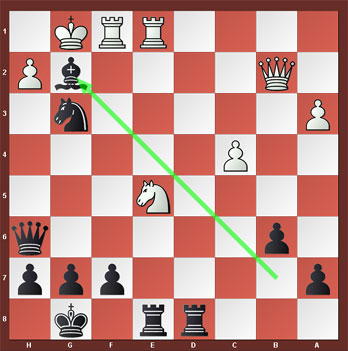
26... Bxg2! (see 4th diagram on left)

Fritz liked (26... Nxe1), taking the Rook first. However, I have a little trick up my sleeve.

Can you see the trick?

Let's see what White can play.

His Rook is obviously under attack twice. So let's consider the candidate move:

(27. Rxf7)

I'm going to take time out here and consider this variation so you have a good idea why this move is bad. There's a problem with this move. Because Black has an even more surprising move in store.

(27... Ba8!!) (see 5th diagram on left) What??!! You probably ask.

Here's the nasty trick.

White cannot play (28. hxg3) (taking the Knight because of (28... Qh1+ - highlighted by red arrow - 29. Kf2 Qh2+) skewering the undefended Queen.

If White doesn't capture the Knight and moves his Rook on f7 away, now comes the killer move:


(30.... Rd2) (highlighted by the yellow arrow) (threatening 31...Qxh2 followed by mate so White must give up the Queen)

If Knight on e5 moves to f3, Black trades Rooks anyway with ... Rxe1 followed by ...Ne5 (yellow arrow) and ....Rd2 and the position is absolutely crushing.

Now let us return to our position (see diagram on left) after 26... Bxg2.

27. Qxg2 (forced because 27. Kxg2 runs into the horrible fork 27....Rd2+! winning the Queen)

Now (27. Nxf7 doesn't work because of 27... Qg6 28. Nxd8 Be4! with threats of 29... Nxf1+ or 29... Ne2+ and best of all, White still cannot play hxg3 because of mate on g2 after Qxg3+)

Now let's get on with what White actually played.

28. Nxf7? (see last diagram below on left)

And now the final trick presents itself.

28.... Qxh2+!

And White is now busted. Interestingly, Fritz didn't like this move. Well.... duh. Of course I am going for the endgame and trade off the Queens.

29. Qxh2 Nxh2
30 Rxe8+ Rxe8 (White Resigns as he is a whole Rook down)

1-0


Phew.

I have no doubt that my chess skills is not up to scratch and my piece co-ordination still lacks finesse. This is an area I definitely need to improve upon.

Wednesday, November 28, 2007

Failing In Tactics

Over FICS, I played against a 1500 rated player and promptly lost despite having an advantage. Bummer!

Here's the position with Black to play.

This position arose from a Reti opening (yes, I do play the Reti Opening). Black has a positional advantage and White's pieces are currently tied up in knots. The White Knights have no good squares to relocate to, the Rooks are passive, the Queen is passive.

And being the absolute idiot that I am, I played 26... Bxb2?? An error of humongous proportions. Do you know why the b2 pawn is taboo?

....... You've probably seen it by now. Because of 27. Ne1 and it's goodbye Bishop! From that point on, it was pretty much downhill all the way.

In this position, I should have played a far stronger move.

Can you see what should Black do to press home the advantage?

Please stop reading now if you do not wish to know the answer.

The correct response is 27...f4!! White has a couple of responses. None are good.

a)
28.exf4 Bxf4!
(see 2nd diagram on left) threatening Bxc1 and Bxg3+ forking King and Queen. The Bishop cannot be recaptured because of Re2 winning the Queen


b)
28.
Qf1 fxe3
29. Qxd3 Rxd3
30. Ne1 Rd2+!!
31. Nxd2 exd2
32. Rb1 Bxg3+! (see 3rd diagram on left) and Black wins (Rxe1 is coming and no force on earth can stop the d-pawn from Queening)


c)
28. Kg2 fxe3
29. Qf3 e2

30. Ne1 Qd1

31. Rc2 Bd4

32. Nxd4 cxd4 (see 4th diagram on left) and Black wins as the next move is d3->d2 and White is powerless to stop one of the pawns from Queening.

Oh well, back to the drawing board!

Tuesday, November 27, 2007

Don't You Just Hate The French Defence?

Folks, I'm learning the French Defence and that means learning both sides of the French.

I find that most players in my club mistake the French Defence as a passive, boring defence much like the Caro-Kann but with the added disadvantage of Black's light-squared bishop being hemmed in (which as Korchnoi so lovingly puts it,"his problem child") and remaining inactive for much of the game.

However, the French is not a passive defence. I've found that it's a dangerous counter-attacking defence. Yes, counter-attacking. That means, you as Black don't sit back and let White squeeze you, you go straight for White's throat while White is messing around and shuffling pieces to break the f7-square.

The long-term strategy behind the French Defence is surprisingly simple. Break down White's center and then break White.

Why play the French Defence? I mean, no super GM plays it at the top level other than GM Morozevich and even then his results in the French as Black have not been spectacular. eg. see this tactical game where Morozevich was slowly but surely losing in this year's Linares (Topalov v Morozevich 1-0).

But less not we forget, openings change like the wind. A decade ago, the Sicilian Najdorf was the (and still is) the main reply to 1.e4 but its presence has been diminished with Kasparov's retirement. Instead, the Ruy Lopez (Anand, Kramnik), the Catalan (Kramnik), Petroff (Kramnik), the Slav/Semi-Slav/Queen's Gambit Declined (Anand, Leko, Kramnik, Topalov) are the rage these days.

In fact, the Ruy Lopez Berlin Defence is so tough to crack that I am now forced to switch openings. I was surprised to encounter it as White during one of my OTB games a month ago vs a 1700 player (which I won but only because my opponent blundered when he had the advantage) but who clearly knew how to play the Berlin Defence.

Anyway, here's a French Defence game I played recently on FICS.

We reached the position (I am Black) as shown 33. Rg4 (see 1st diagram on right).

White is trying his best to break down the position but I've got everything tidied up.

Now imagine the board without the Queens and the minor pieces. What do you see?

Bingo! Black has a strong central pawn majority and it is these pawns that will give Black an advantage in the endgame.

The isolated pawn on e5 will fall and I still have pawn triggers of f6 or g6 (at the opportune moment) to cause serious damage to White.

I therefore, not surprisingly, head straight for the endgame.

33. ... Rc4 (trading off the Rooks naturally)
34. Rgf4 Rxf4 35. Rxf4 Rc4 36. Rf2 (waste of time) Bc5 (even if White didn't move I am relocating my Bishop to c7 for reasons mentioned below)
37. Rf1 Re4
38. b4 Bb6
39. Rf3 (see 2nd diagram on right)

Now this is my plan. I intend to attack the e5 pawn - it cannot be defended because of the vulnerability of the back rank check (losing the Queen in the process). The dark-square bishop will slice through the b8-h2 diagonal.

39.... Bc7
40. Qh2 Bxe5

41. Bg3 Bxg3
(I was so tempted to do 42. Re1+! and then trading off his Queen for my Rook and Bishop but I feared the position might be complicated. I was thinking to myself. I have a winning position, I just need to keep my pieces on the board. Put more pressure and White will crack soon enough)
42. Qxg3 f6
43. Qh3 Re1+

44. Kh2 Qb8+

45. g3 Qe5
(see 3rd diagram on right) (now it is all over, my Queen threatens c3, e2+ and h5 and my Rook threatens e2. If White plays 46. Qg2 Qxh5+ 47. Qh3 Re2+ wins the Queen)
46. Rf2 Qxc3 (White's Queenside pawns will get gobbled up and the pawns simply march down to win) 0-1

Sunday, November 25, 2007

Czech Mate

Excuse the bad pun.

I'm still wrapping my head around using Chess Publisher and am loving it. This was a team match correspondence game played this year.

I've never understood the Czech Benoni (I doubt I ever will). I ran this through Fritz. My own comments are in bold.


In the game above, I find I didn't have to make any mistakes. My one worry was castling Queenside right into his Bishop pin. But I took a look around the board and couldn't find anything threatening and went ahead with it.

I'd noticed that certain openings can be played based on general understanding, and for other lines, move memorisation is required. I'll be honest, I've never remembered any line beyond the 6th or 7th move so I do not play lines like the Najdorf and the Slav because the amount of theory is too mind boggling.

At my level (which I estimate to be around 1200), I just need to understand concepts and general ideas, practice on my tactics and perfect my endgame technique. Until I get to at least 1800 level, I do not intend to bother with deep move memorisation. However, what I do also want to acquire is knowledge about pawn structures and ideas behind certain openings. I feel this is an invaluable knowledge tool to any aspiring chess player.

Thursday, November 22, 2007

How Not To Play Vs The French Defence

I've finally decided to take the plunge and have a go at Chess Publisher instead of constantly loading my games to Fritz and then copying and pasting the images to the blog.

ChessPublisher is still a little temperamental at times but overall, the change has been very positive and I am very pleased with the results. I would like to give my utmost thanks to Andrew Ooi for giving the chess blog world a terrific way to present chess games. His contribution cannot be any more understated.

Here's a game I just played in FICS. I decided to vary my repertoire a little and play the French Defence. I have not added in a lot of game comments as the game was simple from start to finish.


Incidentally, because of studies, I have also forfeited my remaining 5 games at my chess club. I have to take 4 Module exams and 2 Finals exam within the next 7 days (it's just not funny). I was running in 3rd place. Oh well, it's only a Rapid competition anyway and it was fun while it lasted.

Getting to the chess club on Wednesdays is fast becoming a huge hurdle to overcome. I finish work at 7pm and the competition starts at 7.30pm. This means, I have to get to my office garage, hop on, blaze full speed to the club (it's about a 15-20 min drive away), park and run up to the club.

I do notice one particular habit forming.

I ALWAYS lose my first game. Without fail. It seems that by the time I get to the club, I'm so hurried that I started to make mistakes. Mistakes I would not normally make (like not seeing a mate in 1 for instance!).

However, usually after my first game, I find that I am much settled down and will start to play at a much improved level and I win more often than not. I guess I have to rethink about joining another chess club soon after my studies. I can't keep doing this week after week.